ABOUT
After leading NSUTMUN's 2025 brand identity, I moved into a UX and leadership role for 2026 to fix what the brand couldn't: registration itself, which ran on a patchwork of Google Forms, Sheets, and Drive links.
I designed a real-time committee portfolio matrix, an on-site payment portal, and direct access to committee guides, replacing that workaround with one flow, rebuilt to match the new brandkit.
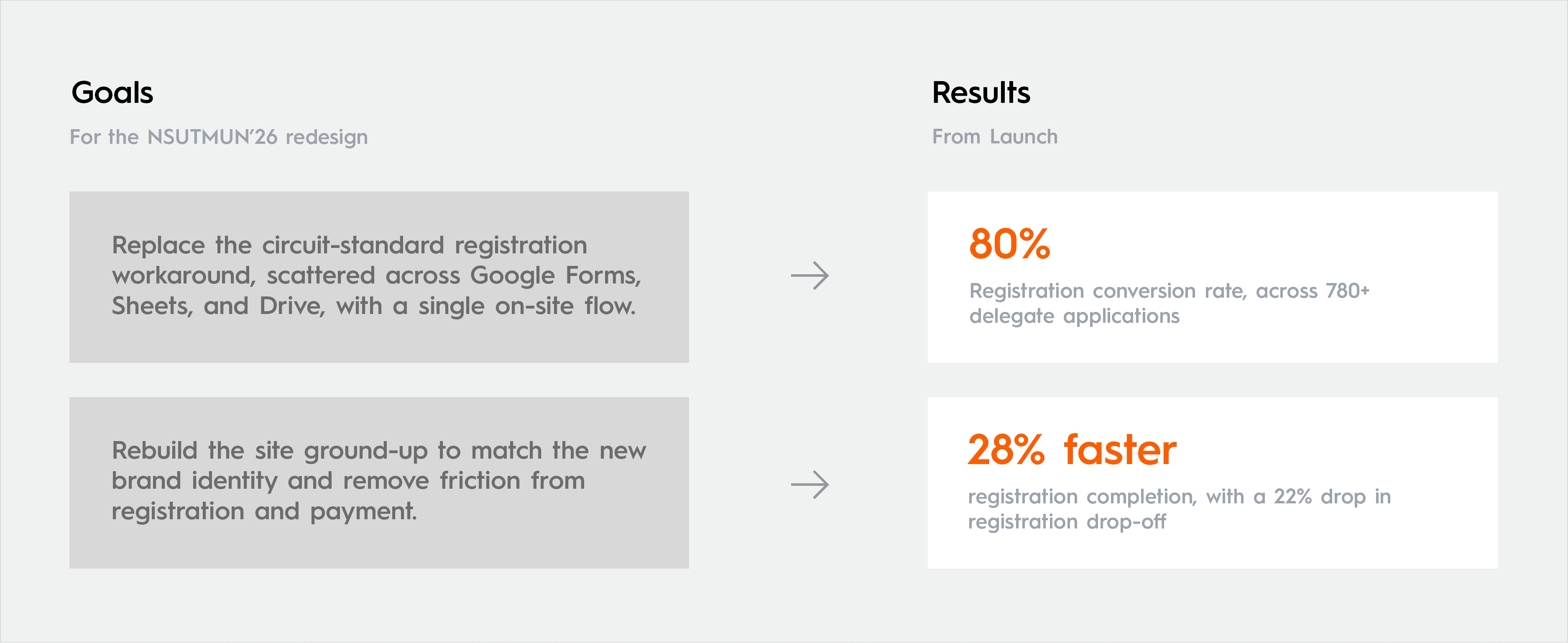
The result? 80% registration conversion across 780+ applications, 28% faster completion, and a 22% drop in drop-off.
MY ROLE
UX Designer
TIMELINE
Jan '26 - May '26
TOOLS
Figma
Illustrator
Figjam
Protopie


OVERVIEW
NSUTMUN is one of India's largest student-run Model UN conferences, drawing 650+ delegates nationally. For the 2025 edition, however, the entire registration and committee-allotment pipeline was pieced together from generic tools never built for the job: a Google Sheets portfolio tracker delegates had to refresh manually, a Forms-based payment flow with no real confirmation loop, and guides and brochures buried in a shared Drive folder. As the event scaled, so did the friction.
SOLUTION
For NSUTMUN 2026, I led a full website rebuild around a single on-site experience: a real-time portfolio matrix replacing the static Sheet, an integrated payment flow replacing Forms, and direct on-site access to committee guides and brochures. The result was an 80% registration conversion rate across 780+ applications, a 28% faster registration process, and a 22% drop in registration drop-off.
Interactive committee selection with committee-specific details
Filterable portfolio directory by availability status
The new registration flow, portfolio matrix, and payment system ran the full delegate pipeline for NSUTMUN 2026, real applications, real allotments, and real payments end to end.
Some data gathered from NSUTMUN 2026:
34% reduction in average time to complete registration, compared to the 2025 Forms-based flow
91% of delegates checked their allotment status via the live matrix within 24 hours of it going live, without a single manual Sheet update
96% of payments processed with zero manual cross-checking required from organizers
INITIAL FINDINGS
Working from feedback collected after the 2025 edition, I mapped out where the existing process broke down for each type of user, setting the direction for what the 2026 rebuild needed to fix.

DESIGN SYSTEM
I built the site's design system around a brand new NSUTMUN identity.
Heading into 2026, NSUTMUN's identity was fully revamped by our junior design team, replacing the 2025 look. My job was translating a print-first identity into something that could run a live, data-heavy product, forms, tables, and interactive states the original brand guidelines never accounted for.

With that direction set, I built a web design system to keep development consistent and moving fast.

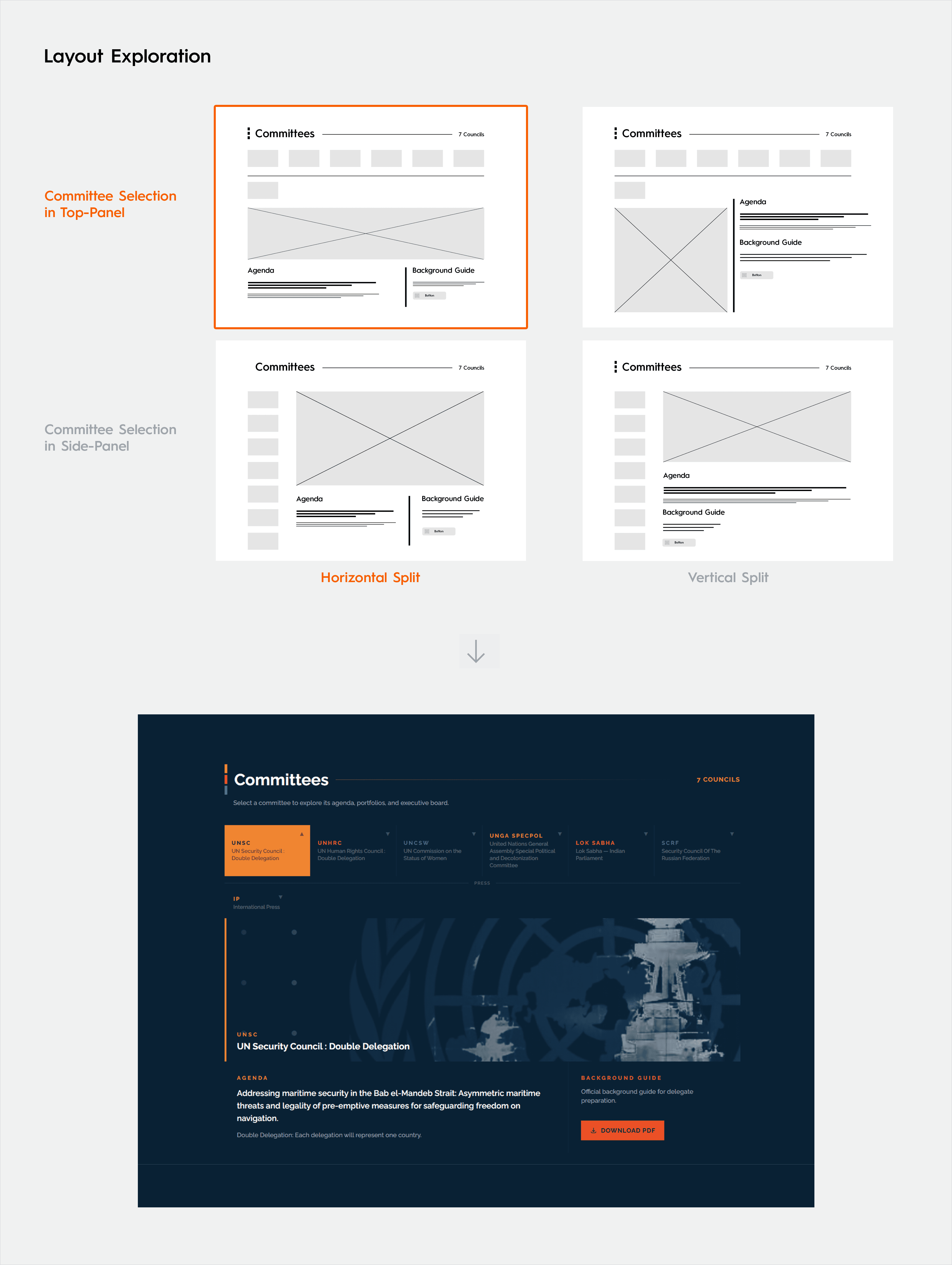
COMMITTEE MATRIX
Delegates needed a live, trustworthy view of their committee allotment.
The matrix ran on a static Google Sheet in 2025, manually updated by organizers and manually refreshed by delegates hoping for a change. I rebuilt it as a live system on the website itself, so status updates were instant. User-forward design was the north star throughout, exploring new layouts and presenting alternatives focused on clarity over migrating what the old sheet already had.
BETA LAUNCH & TESTING
We went live during our society's internal intra-MUN.
I beta launched the new site during our society's internal intra-MUN and collected feedback from society members. We tested the matrix and payment flow with real users and gathered feedback on the experience, then made changes based on that feedback ahead of the full 2026 conference.
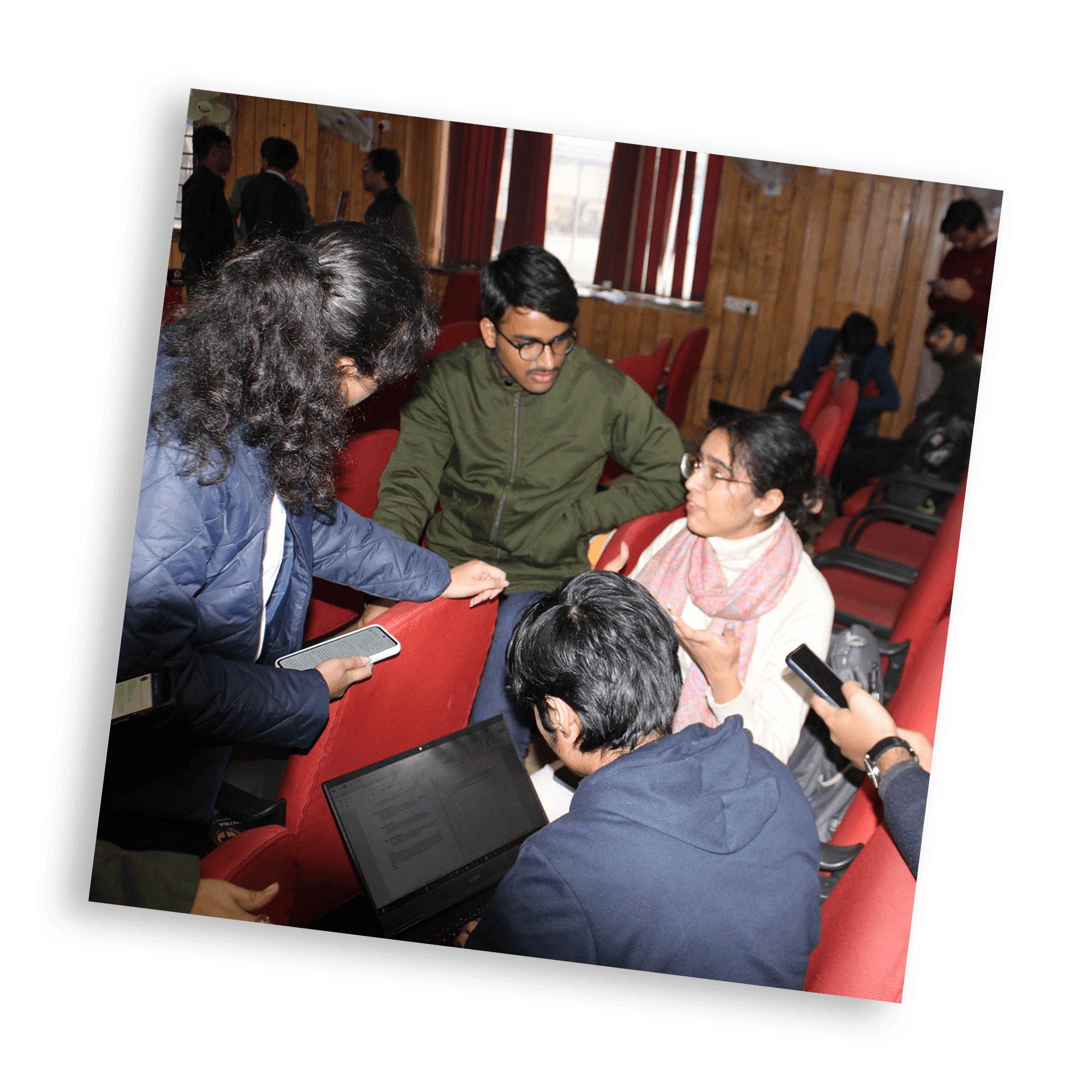
Intra-MUN 2026! Some of the most
fun I have had as a senior :)
ITERATING WITH INSIGHTS
Feedback from the intra-MUN beta pointed to the same complaint over and over, delegates preparing for their committee had to bounce between the brochure page, the registration page, and the committee page just to get everything they needed for one job.

The real issue wasn't how pages were labeled, it was that related information was scattered across too many of them. Merging them into a single flow was the clear fix.

The consolidated structure paid off at the next event, delegates moved through what they needed far more smoothly.

THE BIG LAUNCH!
After the intra-MUN beta, the rebuilt site ran the full registration and committee-allotment pipeline for NSUTMUN 2026 itself, serving 780+ delegate applications.
With the new site, we were able to run a smoother registration process that met the society's goals:
The success of this rebuild set a new standard for how the society runs registration going forward, with the consolidated system already planned as the foundation for future editions.

The Results
With the key issues identified, we translated those insights into a set of focused design solutions.
PROBLEM
A Split Delegate Experience
To register, delegates bounced between a spreadsheet for their portfolio status, a form for payment, and a shared folder for documents, none of which talked to each other.
SOLUTION
One Unified Website Running the Entire Pipeline
Delegates applying for the first time often had to check three different places just to confirm they'd actually registered, a Sheet for status, a Form receipt for payment, and a Drive link for their documents. It was easy to miss a step and not realize it until it was too late.
The rebuild brings all of that into one place. The moment a delegate applies, pays, or gets allotted a committee, it shows up on the site itself, so there's no more piecing things together across three different tools.
PROBLEM
Manual organizer overhead
Every update meant hands-on work, updating the portfolio Sheet by hand, cross-checking Forms submissions against payments received, and re-sharing Drive links whenever a delegate asked for a document again.
SOLUTION
Automated Updates Across the Entire Pipeline
Before this, organizers spent hours each week on work that had nothing to do with actually running the conference, updating spreadsheets, checking payment screenshots, resending the same folder link to delegates who'd lost it.
Now, the site handles it. Status updates, payment confirmations, and document access all happen automatically, freeing organizers to focus on the parts of the conference that actually needed their attention.
REFLECTION
What I Learned
Design with engineering throughout the process, not after it.
Design and engineering evolved together throughout the project. Collaborating closely on interactions, edge cases, and implementation details helped us make faster decisions and build a system that stayed coherent from concept through development.
Beta testing turned assumptions into evidence.
Our internal MUN acted as a live beta environment, letting us observe real delegate behavior and identify friction before the public rollout. Those insights directly informed refinements to the flow, interactions, and overall system.